Virtual Museum “Mathematics and Arts”
This presentation introduces some final outputs of a PhD research work
«Mathematics education, Western and Eastern teaching approaches combined with the Arts»
carried out by
Michela Tramonti, PhD
Institute of Mathematics and Informatics - Bulgarian Academy of Sciences, Sofia (Bulgaria)
Research objectives
- Exploiting the possibility to find a combination between Western and Eastern approaches in mathematics teaching/learning.
- Finding in the arts the result of this integration.
- Demonstrating the objectives above intends to encourage a meaningful learning in the development of the science competences, to improve the school performance and higher interest towards a future perspective in the scientific field.
Model proposed
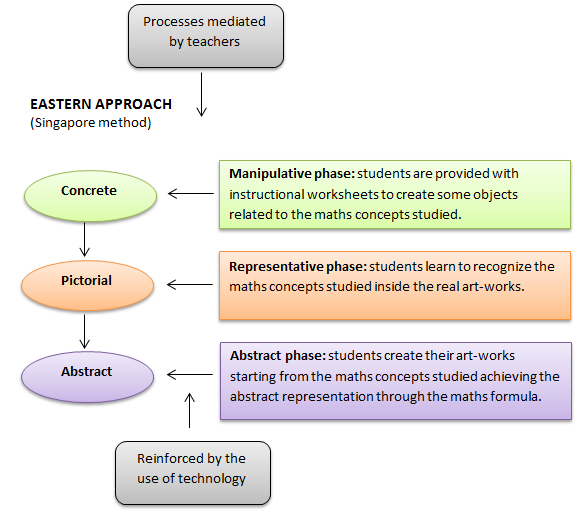 The proposed learning and teaching approach is inspired by the Singapore method for mathematics study. It is basically characterized with the use of visual and model-drawing strategies which underline mathematics and surrounding world problems and leave out the memorization occurring through repetitive exercises. It is applied to the mathematics study through a process structured into three phases: concrete, pictorial and abstract. The process allows secondary school students to start from a symbolic representation through the concrete mathematical experience to reach abstract concepts of what they are studying.
This method is reinforced by the introduction of two new elements, the use of Arts and Technology as shown in the figure.
During the Concrete phase students carried out experiences and became familiar with specific mathematics objects or concepts through their manipulation using digital tools. Students used “Geogebra" application for this first step.
In the Pictorial phase, they learned to recognize math in the art exploiting the potentialities to work both in group and individually. Students were expected to find in the habitual surrounding objects the mathematical concept studied, for example “symmetry”. In this step, they used not only what is strictly known as the art-works but they also found the mathematical concept in other contexts as in nature.
Finally, on the base of the mathematics concept studied, students created their own art-works by using their creativity.
Virtual Museum
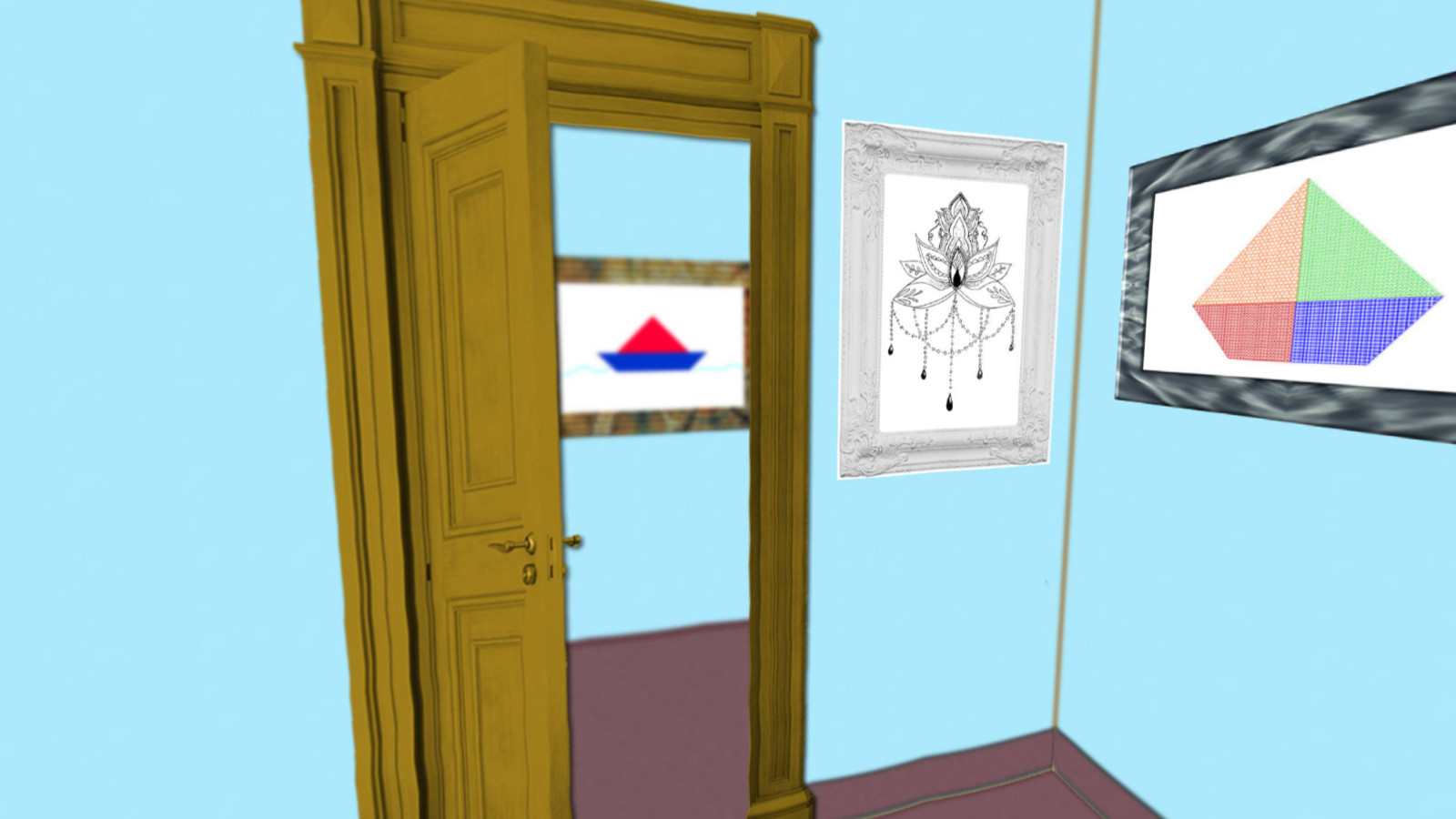 Some of the “art-works” created by students were selected to be presented in a virtual museum. These are related to the study of the symmetry realized with two different target groups from Italian secondary schools – first grade (11-13 years old) and second grade (14-16 years old). The aim is to show both hand-made and digital art-works produced by students during this stage.
The virtual museum is composed of two rooms where these “art-works” can be seen. Every frame on the wall is an interactive object. In fact, by clicking them, users can get some information about the author(s), the object created and its relation to the real world, as well as the mathematics concept represented.
By clicking the frame next to the door of the second room, entitled “Mathematics and Arts”, the user lauches a video showing the key moments of the experimentation phase realized with the students during the symmetry study.
The virtual museum was implemented by
Institute for Computer Science and Control, Hungarian Academy of Sciences, (MTA SZTAKI)
H-1111 Budapest, Hungary, Kende u. 13-17.
specifically by
Zsolt László Márkus (markus.zsolt@sztaki.mta.hu),
Zsolt Weisz (weisz.zsolt@sztaki.mta.hu),
Miklós Veres (veres.miklos@sztaki.mta.hu).
in collaboration with
Institute of Mathematics and Informatics - Bulgarian Academy of Sciences from Bulgaria